Setup
The numbers
Thermal gradient
Day: a real gradient, 29–32°C warm against 24–29°C cool, so the animal chooses. Night: 21–24°C.
Why
Same scale on every sheet here, so two species compare by eye.
The sheet stateswarm 29-32 °C / cool 24-29 °C / night 21-24 °C
UVB
The sheet statesA 5% T8 UVB tube, 2-5% T5 uvb tube or more powerful but smaller unit
Drag the sun. Radiated ratsnake is Diurnal, so what it is doing changes with the light. The sheet states a night temperature, and the rail follows it.
Enclosure and conditions
What your climate adds
This sheet states a range to hold. Your local climate decides how much work holding it is. Pick the nearest city: nothing is sent anywhere, the choice stays in this browser.
What it needs
Every line above is deduced from a value this sheet states, and names which one. Nothing here is a general recommendation. What the sheet does not state is listed too, rather than left out: a kit that looks complete is worse than one that names its gap.
Food
Diet
Feeding rhythm
Twenty-eight days, one row. Each band is a meal window. The sheet gives several ages on one line; this is the adult figure.
Why
The windows widen as they go because the interval is a range: four meals after a 10–14 day cycle land anywhere between day 40 and day 56.
The sheet statesAs hatchlings, fed weekly on defrosted pinky mice, the food size should be increased until the snake is taking large mice or even jumbos; adult rat snakes can be fed once every two weeks
Daily life
Behaviour and handling
Health
When to see a vet
Thai-native (WARPA). Defensive but tames; large active diurnal. Captive-bred sourcing matters.
The species
Identity
Reproduction
Good to know
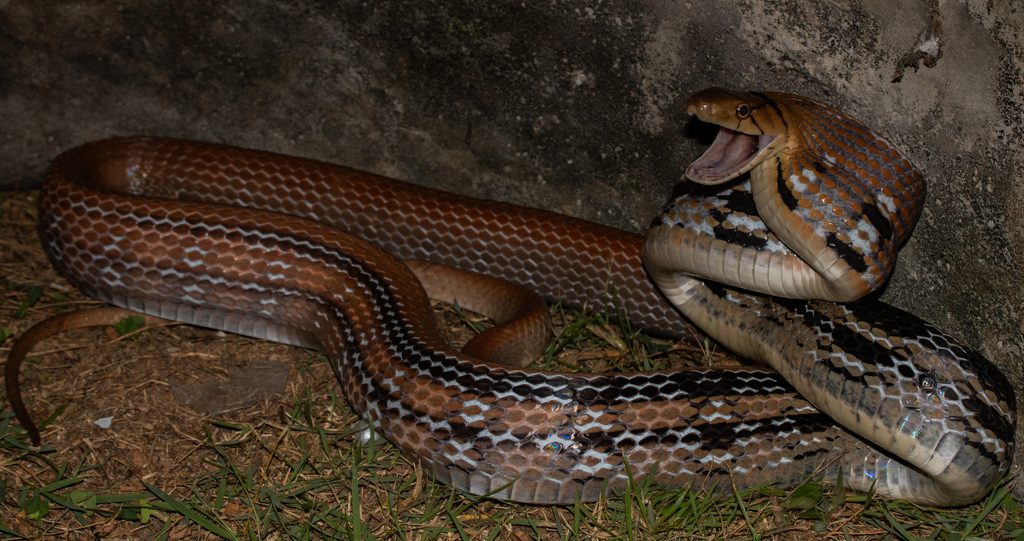
- A common Thai native famous for its defensive 'cobra-like' hood-and-strike bluff when startled.
National law is not global, and we hold no national wildlife law for any country, Thailand included. Check your own authority before buying or selling.
Questions & sources
Common questions
Is it dangerous?
Not venomous, but this is a famously defensive snake. It flares its neck, strikes hard, and the bite bleeds.
Does it calm down?
Captive-bred ones can settle a lot with patient regular handling. Wild-caught adults often never really do.
How big does it get?
Around 1.5 to 1.8 metres, athletic and fast. It needs a long, very secure enclosure.
What does it eat?
Rodents, and it is usually an enthusiastic feeder. Use tongs so it never links your hand with food.
https://keepr.pet/husbandry/en/coelognathus-radiatus
Others in this group
What this sheet states
This sheet states 6 of 7 of the fields this product runs on. What is missing turns something off: humidity instrument and audit. We show the gap rather than fill it with a plausible number.
UVB is measured but does not count: it is absent from 420 of 678 sheets, and on most of them that is not a gap, since a nocturnal snake's sheet has no reason to state a UV index. Counting it would call the library incomplete without cause.