Drag the sun. Boa Constrictor is nocturnal, so what it is doing changes with the light.
The way of life is written in this sheet, word for word. The climate words summarise the two figures above them, they do not add to them.
CITES II is a global listing and holds in every country. National law is not global, and we hold no national wildlife law for any country, Thailand included. Check your own authority before buying or selling.
https://keepr.pet/husbandry/en/boa-imperator
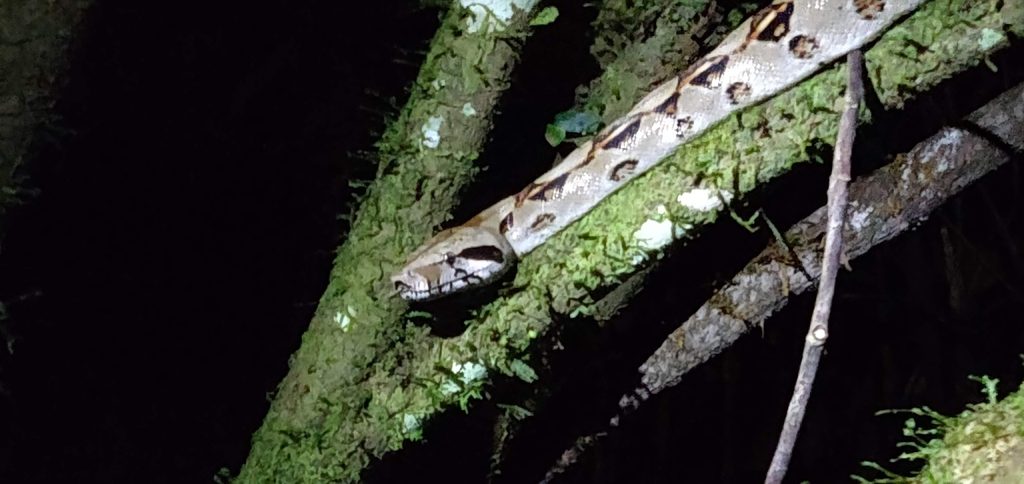
Photographed by an observer on iNaturalist and published under a Creative Commons licence; the photographer and the licence are named under the image. It is not an animal of ours, and no animal was handled by us to produce it.
The numbers
Thermal gradient
A real gradient, 31–33°C warm against 26–28°C cool, so the animal chooses. The sheet states no separate night figure.
Why
Same scale on every sheet here, so two species compare by eye.
The sheet stateswarm 31-33 °C (88-90 °F) / cool 26-28 °C (79-82 °F)
Humidity
The sheet states60-75% (mist / humid hide)
UVB
The sheet statesRecommended (low–moderate)
Identity
Adult size
The size the sheet states for a grown animal. This sheet gives a figure per sex; the one drawn is marked.
Why
Two drawings, because they answer two questions. The silhouette is at true scale against a 1.75 m person: it says how big this animal actually is, which no number does for someone who has never seen one. The bar under it is logarithmic and shared by every sheet here, so a 2 cm isopod and a 4 m python both stay readable on the same axis and two species can be compared at a glance.
Morphs
15 morphs, with how each one is inherited.
How common this animal is
Relative Google search interest for the species as a pet, 2020. The scale is relative within the study: 100 is the most searched reptile it measured, not a count of animals. Reptiles only, and only the species the study measured. An absent value means the study did not measure that species, not that nobody keeps it.
Valdez JW (2021), Using Google Trends to Determine Current, Past, and Future Trends in the Reptile Pet Trade, Animals 11(3):676
Enclosure and conditions
Enclosure
Drawn from the stated numbers. Only what the sheet states is drawn inside.
Why
The rectangle carries the exact width-to-height ratio of the figures above it, and the ruler under it places that width on the 0–250 cm scale every sheet here shares, so two species still compare at a glance. Nothing is added that the sheet does not name: a lamp drawn on a sheet that never mentions one would be invented equipment. What the sheet leaves out is listed rather than left blank, because an empty tank reads as « none needed ».
The sheet states180 × 60 × 60 cm (6×2×2 ft) minimum
What your climate adds
This sheet states a range to hold. Your local climate decides how much work holding it is. Pick the nearest city: nothing is sent anywhere, the choice stays in this browser.
Diet
Feeding rhythm
Twenty-eight days, one row. Each band is a meal window. This sheet states a figure for each age, so each age has its row.
Why
The windows widen as they go because the interval is a range: four meals after a 10–14 day cycle land anywhere between day 40 and day 56. A young animal's row is drawn only where the sheet gives one: working it out by dividing the adult interval would be inventing a ration.
The sheet statesRats → larger rodents / rabbits (adults) · Every 2–4 weeks (avoid obesity)
Behaviour and handling
Reproduction
Life course
Read from the lifespan and maturity the sheet states, for animals in care and not in the wild.
Why
The minimum commitment is the low end of that lifespan, and the reproductive window is what is left after maturity: both are subtractions on stated figures, not figures of their own.
Common health problems
When to see a vet
Good to know
- Gives birth to live young rather than laying eggs.
- One of the most morph-rich large snakes (albino, hypo, motley, kahl…).
- Uses heat-sensing and constriction, not venom, to hunt.
Common questions
How big does it really get?
Commonly 6–8 ft; a serious long-term commitment.
Is it dangerous?
Not venomous, but large & strong: respect + experience needed.
Beginner-friendly?
Better as a second snake after a corn/ball.
What it needs
Every line above is deduced from a value this sheet states, and names which one. Nothing here is a general recommendation.
- Large enclosure 180×60×60+
- Thermostat + guard
- Radiant heat panel
- Large sturdy hides
- Cypress substrate
- Large water tub
- UVB fixture
- F/T rats
Sources
Others in this group
What this sheet states
Every field this product runs on is stated here. That is not a claim that the values are right: it says what the sheet states, not whether it is true. Whether a human has read it is the badge at the top of this page.
UVB is measured but does not count: it is absent from 421 of 678 sheets, and on most of them that is not a gap, since a nocturnal snake's sheet has no reason to state a UV index. Counting it would call the library incomplete without cause.