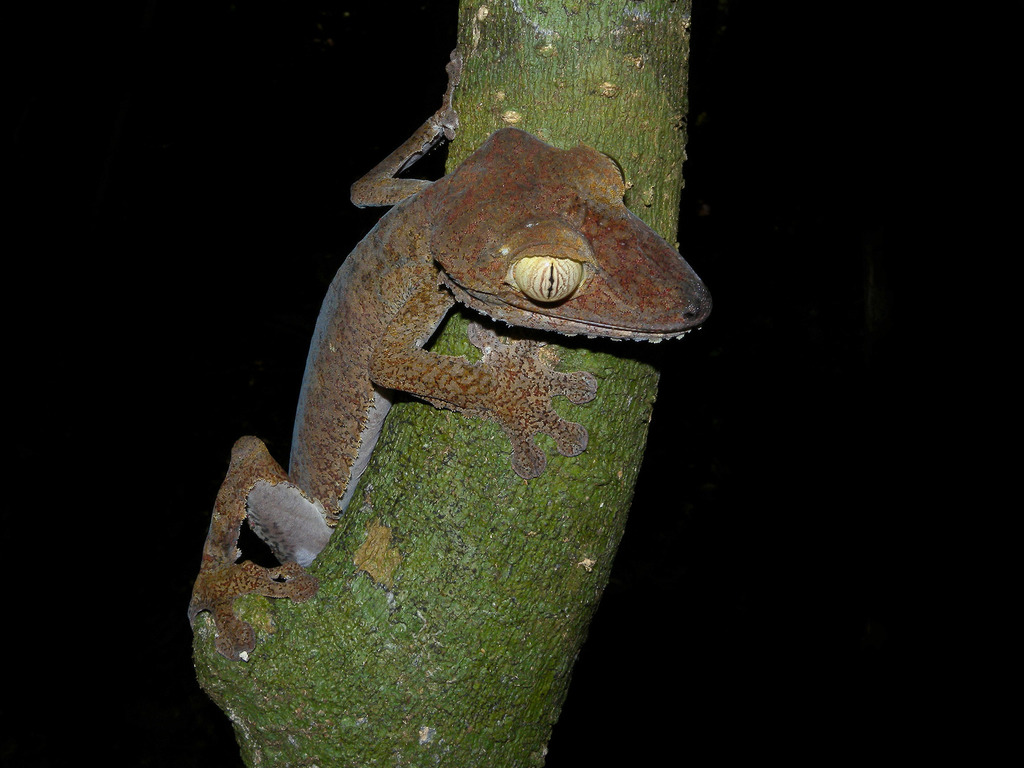
ภาพถ่ายโดยผู้สังเกตการณ์บน iNaturalist เผยแพร่ภายใต้สัญญาอนุญาตครีเอทีฟคอมมอนส์ ชื่อผู้ถ่ายและสัญญาอนุญาตอยู่ใต้ภาพ ไม่ใช่ภาพของสัตว์ที่เราเลี้ยง
ค่าหลัก
Thermal gradient
Day: a real gradient, 28–29°C warm against 25–27°C cool, so the animal chooses. Night: 21–24°C.
Why
Same scale on every sheet here, so two species compare by eye.
The sheet stateswarm 28-29 °C / cool 25-27 °C / night 21-24 °C
Humidity
The sheet statesfimbriatus: 60-70% day, 75-85% night
UVB
The sheet statesFerguson Zone 1; the UVI at the basking branch should be between 1.0-2.0; Arcadia T5 SO ShadeDweller Arboreal 2.4% at 3-4″ / 7-10cm, Arcadia T5 SO ShadeDweller Max 2.5% at 6-9″ / 15-23cm, Arcadia T5 SO ShadeDweller 7% at 8-12″ / 20-30cm, Arcadia T5 HO Forest 6% or Zoo Med T5 HO Reptisun 5.0 at 14-20″ / 35-50cm; the UVB that you choose should span 50-100% of the enclosure's length
ข้อมูลชนิด
ตู้เลี้ยงและสภาพแวดล้อม
Enclosure
Drawn from the stated numbers. Only what the sheet states is drawn inside.
Why
The rectangle carries the exact width-to-height ratio of the figures above it, and the ruler under it places that width on the 0–250 cm scale every sheet here shares, so two species still compare at a glance. Nothing is added that the sheet does not name: a lamp drawn on a sheet that never mentions one would be invented equipment. What the sheet leaves out is listed rather than left blank, because an empty tank reads as « none needed ».
The sheet states24x24x48 (60x60x120 cm) or 36″x18″x36″ (90x45x90 cm) recommended for: fimbriatus (single)
What your climate adds
This sheet states a range to hold. Your local climate decides how much work holding it is. Pick the nearest city: nothing is sent anywhere, the choice stays in this browser.
อาหาร
Feeding rhythm
Twenty-eight days, one row. Each band is a meal window. The sheet gives several ages on one line; this is the adult figure.
Why
The windows widen as they go because the interval is a range: four meals after a 10–14 day cycle land anywhere between day 40 and day 56.
The sheet statesCrickets / Darkling beetles / Grasshoppers/Locusts / Snails / Dubia roaches / Discoid roaches / Red runner roaches / Hornworms / Silkworms / Wax moths; Juveniles should be fed daily; adults can be fed every other day; Offer as much as they can eat in one night
คำถามที่พบบ่อย EN
Is it hard to keep?
Yes, one of the hardest geckos we sell. It needs cool nights, heavy nightly misting and a tall planted enclosure.
Can I handle it?
No. They are delicate and stress badly. Strictly a display animal for experienced keepers.
How big does it get?
Up to around 30 centimetres, one of the largest leaf-tailed geckos.
Does it bite?
It gapes and screams as a bluff. A bite is possible but the display is mostly theatre.
อุปกรณ์ที่ต้องมี EN
Every line above is deduced from a value this sheet states, and names which one. Nothing here is a general recommendation.
แหล่งอ้างอิง
ชนิดอื่นในกลุ่มเดียวกัน
What this sheet states
This sheet states 5 of 7 of the fields this product runs on. What is missing turns something off: day/night engine and awake count on the globe, the diet section. We show the gap rather than fill it with a plausible number.
UVB is measured but does not count: it is absent from 421 of 678 sheets, and on most of them that is not a gap, since a nocturnal snake's sheet has no reason to state a UV index. Counting it would call the library incomplete without cause.