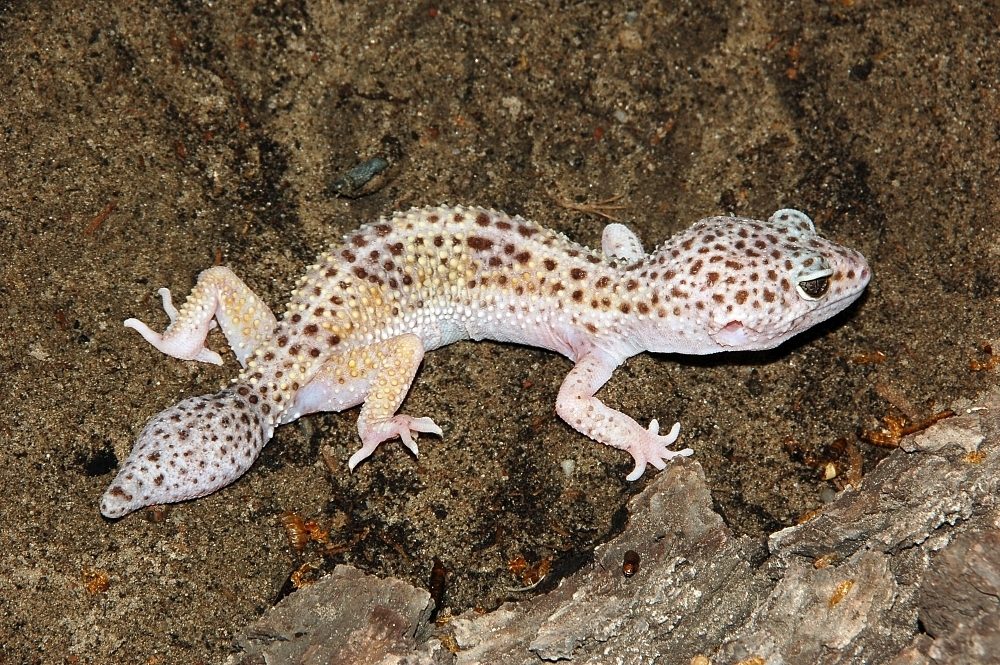
Puis-je le garder ?

Comparez votre installation à cette fiche

Installation

Les chiffres

Gradient thermique

152025303540 °C
21–24°Côté frais
31–33°Côté chaud
16–20°Nuit

Le jour, un vrai gradient : 31–33°C côté chaud contre 21–24°C côté frais, l'animal choisit. La nuit : 16–20°C.

Pourquoi

Même échelle sur toutes les fiches d'ici : deux espèces se comparent à l'œil.

La fiche énoncewarm 31-33 °C (88-92 °F) / cool 21-24 °C (70-75 °F) / night Down to ~16-20 °C ok

Hygrométrie

30–40%Hygrométrie visée

La fiche énonce30-40% + humid hide 70-80%

UVB

Facultatifbénéfique

La fiche énonceLow-level recommended (thrives)

Une partie de ceci n'est pas sur la page que nous citons. Nous l'avons ouverte le 10 août 2026 et certains des degrés ci-dessus n'y sont pas énoncés. Les valeurs ci-dessus sont peut-être justes, mais nous ne pouvons pas vous montrer d'où elles viennent, et personne ici ne les a confrontées à une deuxième source. Tout ce qui touche à un animal malade va à un vétérinaire spécialisé, pas à une page. petmd.com

14:00
Jour

Faites glisser le soleil. Leopard Gecko est Crépusculaire, donc ce qu'il fait change avec la lumière. La fiche énonce une température de nuit, et le rail la suit.

Terrarium et conditions EN

Terrarium

substrat31–33 °Ccachette chaudecachette fraîchepoint d’eau30–40 % RHtube UVB90 cm45 cm
côté chaudcachette chaudecachette fraîchepoint d’eausubstrattube UVB
50100150200 cm
90 × 45 × 45 cmLargeur × profondeur × hauteur
41dm² au sol

Dessiné à partir des chiffres énoncés. Seul ce que la fiche énonce est dessiné dedans.

Pourquoi

Le rectangle porte le rapport exact largeur/hauteur des chiffres au-dessus de lui, et la réglette dessous place cette largeur sur l’échelle 0–250 cm que partagent toutes les fiches : deux espèces se comparent donc encore d’un coup d’œil. Rien n’est ajouté que la fiche ne nomme : une lampe dessinée sur une fiche qui n’en parle jamais serait du matériel inventé. Ce que la fiche tait est listé plutôt que laissé vide, parce qu’un bac vide se lit « rien à mettre ».

La fiche énonce90 × 45 × 45 cm (36×18×18 in)

Zone chaude (cachette chaude)
31–33 °C (88–92 °F)
UVB (obligatoire)
Low-level recommended (thrives)
Substrat
Firm: tile / excavator clay (no loose sand for young)
Cachettes
3 hides (warm, cool, humid)
Eau
Small shallow dish

Ce que votre climat ajoute

Cette fiche énonce une fourchette à tenir. C'est votre climat qui décide du travail que ça demande. Choisissez la ville la plus proche : rien n'est envoyé nulle part, le choix reste dans ce navigateur.

Ce qu'il lui faut EN

Un bac d’au moins 90 × 45 × 45 cmparce que Terrarium — 90 × 45 × 45 cm (36×18×18 in)
Une source de chaleurparce que Température — warm 31-33 °C (88-92 °F) / cool 21-24 °C (70-75 °F) / night Down to ~16-20 °C ok
Un thermostat pour la régulerparce que Température — warm 31-33 °C (88-92 °F) / cool 21-24 °C (70-75 °F) / night Down to ~16-20 °C ok
Un thermomètreparce que Température — warm 31-33 °C (88-92 °F) / cool 21-24 °C (70-75 °F) / night Down to ~16-20 °C ok
De quoi vérifier la valeur de nuitparce que Température — warm 31-33 °C (88-92 °F) / cool 21-24 °C (70-75 °F) / night Down to ~16-20 °C ok
Un hygromètreparce que Hygrométrie — 30–40% + humid hide 70–80%
UVB, énoncé comme bénéfique plutôt que nécessaireparce que UVB — Low-level recommended (thrives)

Chaque ligne ci-dessus est déduite d’une valeur que cette fiche énonce, et elle dit laquelle. Rien ici n’est une recommandation générale.

  • Terrarium 90×45×45
  • Heat mat + thermostat
  • Low UVB
  • 3 hides (incl. humid)
  • Tile/clay substrate
  • Calcium + D3 + multivit
  • Feeder insects
  • Thermo/hygrometer

Nourriture

Alimentation EN

Rythme alimentaire

Juvénile
tous les 1 d
Adulte
tous les 2–3 d
14Repas en 28 jours · adulte

Vingt-huit jours, une rangée. Chaque bande est une fenêtre de repas. Cette fiche énonce un chiffre par âge, donc chaque âge a sa rangée.

Pourquoi

Les fenêtres s'élargissent au fil du temps parce que l'intervalle est une fourchette : quatre repas après un cycle de 10 à 14 jours tombent n'importe où entre le 40e et le 56e jour. La rangée du jeune n’est dessinée que là où la fiche en donne une : la calculer en divisant l’intervalle adulte reviendrait à inventer une ration.

La fiche énonceInsects: crickets, dubia, BSF larvae · Every 2–3 days

Base de l'alimentation
Insects: crickets, dubia, BSF larvae
Taille des proies
≤ space between the eyes
Quantité
~2 bugs per 1 in length / 15-min feed
Juvéniles
Daily
Adultes
Every 2–3 days
Calcium
Dust calcium (no D3) most feeds
Vitamines / D3
Multivit + Ca+D3 1–2×/week

Au quotidien

Comportement et manipulation EN

ManipulationTolerant; support, never grab the tail
Autotomie caudaleDrops tail if grabbed/stressed (regrows)
CohabitationBest solo; never 2 males
DéfenseRarely bites
Avec des enfantsGreat, supervised

Santé

Problèmes de santé fréquents EN

Metabolic bone disease
Signesweak/bent limbs, tremors
Préventionsupplement Ca/D3 + provide UVB
Impaction
Signesfrom loose substrate ingestion
Préventionfirm substrate + correct prey size
Dysecdysis (stuck shed)
Signesretained skin on toes/tail
Préventionprovide a humid hide
Overheating / cool temps
Signeslethargy, poor digestion
Préventioncorrect thermal gradient

Quand consulter un vétérinaire EN

This is not veterinary advice. If red flags appear, consult a qualified exotic (herp) veterinarian. Quarantine new arrivals 30–90 days.

Signaux d'alerte

  • open-mouth breathing
  • months of weight loss
  • stargazing
  • persistent regurgitation

L'espèce

Identité EN

Taille adulte

À l'échelle, contre une personne de 1,75 m

1,75 m20–25 cm

Échelle logarithmique, la même sur toutes les fiches

1520100400 cm
20–25 cmDu museau à la queue, adulte

La taille que la fiche énonce pour un animal adulte.

Pourquoi

Deux dessins, parce qu’ils répondent à deux questions. La silhouette est à l’échelle réelle contre une personne d’1,75 m : elle dit à quel point l’animal est grand, ce qu’aucun nombre ne fait pour quelqu’un qui n’en a jamais vu. La barre en dessous est logarithmique et partagée par toutes les fiches d’ici : un cloporte de 2 cm et un python de 4 m y restent lisibles sur le même axe, et deux espèces se comparent d’un coup d’œil.

Famille / ordre
Eublepharidae / Squamata
Répartition
Rocky arid grassland & desert
Taille adulte
20–25 cm
Longévité (en captivité)
15–20 yrs (up to 25+)
Activité
Crepuscular / nocturnal; terrestrial
Tempérament
Docile, hardy, easy to tame

Morphs

21 morphs, avec le mode de transmission de chacun. 4 d'entre eux ont un coût documenté pour l'animal, et ceux-là viennent en premier.

Risque pour l'animal4défaut neurologique documenté ou forme super létale
Dreamsickle (combo)comboCarries Enigma + W&Y → neuroForme super : —Risque pour l'animal
EnigmaDominantEnigma Syndrome — neurological (balance/circling/head-tilt). Avoid.Forme super : —Risque pour l'animal
Lemon FrostCodominantIridophoroma: >80% tumours (SPINT1). Discouraged.Forme super : (worse in super)Risque pour l'animal
White & YellowCodominantW&Y syndrome (tremors/circling) in someForme super : —Risque pour l'animal
Sans risque connu17couleur et motif seulement
Bell AlbinoRécessifAlbino strain 2Forme super : —
Black NightSélection polygéniqueMelanistic lineForme super : —
BlizzardRécessifPatternlessForme super : —
Bold StripeSélection polygéniqueForme super : —
Carrot TailSélection polygéniqueForme super : —
Diablo Blanco (combo)comboBlizzard + Rainwater + EclipseForme super : —
EclipseRécessifSolid eyesForme super : —
Gem / TUG SnowCodominantForme super : —
GiantCodominantSize geneForme super : Super Giant
Mack SnowCodominantSuper = solid-eyed Super SnowForme super : Super Snow
Marble EyeRécessifForme super : —
Murphy PatternlessRécessifForme super : —
Rainwater AlbinoRécessifAlbino strain 3Forme super : —
RAPTOR (combo)comboTremper Albino + Eclipse + patternlessForme super : —
Super Hypo / BaldySélection polygéniqueForme super : —
TangerineSélection polygéniqueLine-bred orangeForme super : —
Tremper AlbinoRécessifAlbino strain 1Forme super : —

À quel point cet animal est répandu

47/100Intérêt de recherche en tant qu'animal de compagnie

Intérêt de recherche Google relatif pour l'espèce en tant qu'animal de compagnie, 2020. L'échelle est relative à l'étude : 100 est le reptile le plus recherché qu'elle a mesuré, pas un nombre d'animaux. Reptiles seulement, et seulement les espèces que l'étude a mesurées. Une valeur absente veut dire que l'étude n'a pas mesuré cette espèce, pas que personne ne la garde.

Valdez JW (2021), Using Google Trends to Determine Current, Past, and Future Trends in the Reptile Pet Trade, Animals 11(3):676

24,904Individus vivants dans les déclarations d'importation américaines

Ce n'est PAS une mesure du nombre d'animaux gardés. Ces déclarations comptent les animaux expédiés pour n'importe quel usage, y compris le commerce alimentaire et l'approvisionnement des laboratoires, et ce sont des registres des États-Unis uniquement. Les trois plus gros volumes de la source sont une grenouille de consommation, une espèce servant d'appât et l'amphibien de laboratoire standard.

Registres de déclaration d'importation et d'exportation de faune LEMIS du US Fish and Wildlife Service, tels que compilés dans le jeu de données reçu

Reproduction EN

Parcours de vie

Jour 0Éclosion
0.8–1 yrMaturité sexuelle
15–20 yrLongévité en captivité
35–60 dIncubation
2 eggs, several clutches/seasonPonte
15 yrEngagement minimum
~14 yrFenêtre de reproduction

Lu sur la longévité et la maturité que la fiche énonce, pour des animaux en captivité et non dans la nature.

Pourquoi

L'engagement minimum est la borne basse de cette longévité, et la fenêtre de reproduction est ce qui reste après la maturité : ce sont deux soustractions sur des valeurs énoncées, pas des valeurs à part entière. La fiche rapporte aussi un record d'environ 25 ans ; c'est un maximum rapporté, pas la fourchette sur laquelle se projeter.

Maturité sexuelle
~9–12 months / ≥ 45 g
Sexage
♂: V-shaped preanal pores + hemipenal bulges
Ponte
2 eggs, several clutches/season
Incubation
~35–60 days; temperature sets sex
Note
26–28 °C→more ♀; 31–32 °C→more ♂

Bon à savoir EN

  • Store fat in their thick tails as an energy reserve.
  • Have movable eyelids (rare among geckos) and lick their eyes clean.
  • One of the first domesticated reptiles: hundreds of morphs exist.
  • One of the first domesticated reptiles — hundreds of morphs exist.
Terrestre · chaud · secD'après la fiche : extrémité chaude 31–33°C, hygrométrie 30–40%

Le mode de vie est écrit dans cette fiche, mot pour mot. Les mots de climat résument les deux valeurs au-dessus d'eux, ils n'y ajoutent rien.

Le droit national n'est pas mondial, et nous ne détenons le droit de la faune d'aucun pays, Thaïlande comprise. Vérifiez auprès de l'autorité de votre pays avant d'acheter ou de vendre.

Questions et sources

Questions fréquentes EN

Do they need UVB?

They thrive with low UVB; can manage on dietary D3.

Why did the tail fall off?

Defense: it regrows (fatter, different look).

Is sand safe?

Avoid loose sand for youngsters (impaction risk).

Pour aller plus loin EN

Dossier de recherche : lu à la source, pas encore recoupé par notre équipe. Chaque chiffre renvoie à la page où il a été lu.

Dans la nature

Natural history

Wild diet

Institutional summary
Large variety of invertebrates; occasional small mammal and seasonal flower are reported by RSPCA.

Institutional natural historyrspca.org.uk

Croissance et état corporel

Biology

Adult length cm

Value
17-25
Sex context
females generally smaller

Single source verifiedreptifiles.com

Captive lifespan years

Value
15-20 typical

Single source verifiedreptifiles.com

Activity

Value
crepuscular

Single source verifiedreptifiles.com

Growth

Rule
Observations are descriptive cohort baselines, NOT universal target weights.

Observations

4.4 g038.2 g300 d52.4 g400 d
Mean weight by age in one captive cohort: a description of that group, not a target weight. pmc.ncbi.nlm.nih.gov
Age
adult
Observed average weight g
60-75
Sample context
same captive longitudinal study; growth slows after ~400 days

Observational cohortpmc.ncbi.nlm.nih.gov

Sex and growth evidence

Healthy adult study

Sample size
18
Health context
Only geckos assessed as having high-to-excellent physical and behavioural health were included; specialist reptile veterinarian assessment and parasite screening were used.
Use
Descriptive sex-specific healthy-study reference, not a diagnostic target.

Females

N
10

Weight g range

38-72

Males

N
8

Weight g range

40.5-87

Academic observationalpmc.ncbi.nlm.nih.gov

Small lab sample

Caveat
Very small experimental sample and substantially lighter adult females than other cohorts; useful as evidence of variation, not as a normative curve.

Subadult

Age months
3-4
N
3

Weight g range

9.2-10.5

Adult female

Age
>1 year
N
7

Weight g range

22.3-26.9

Academic small samplepmc.ncbi.nlm.nih.gov

Sex determination

System
temperature-dependent sex determination

Academicpubmed.ncbi.nlm.nih.gov

Body condition

1Emaciated

No visible fat deposits; vertebral column easily visible; eyes sunken.

2Thin

Minimal fat deposits; tail straight/thin; vertebral column visible but not prominent.

3Average

Tail slightly plump; vertebral column not easily seen; abdomen slightly rounded.

4Fat

Tail fat deposits noticeably thickened; abdomen wide relative to body.

5Obese

Tail very rounded/thick; abdomen very wide relative to body.

Veterinarian-scored captive breeder cohort in Thailand

Metrics

Tail diameter
Useful longitudinal metric alongside body weight and BCS.
Note
In the Chiang Mai cohort, smaller tail diameter was significantly associated with Cryptosporidium infection/wasting; track trend rather than one absolute universal cutoff.

pmc.ncbi.nlm.nih.gov

Distinguer mâles et femelles

Sexing evidence

Practical threshold
Reliable external sexing described once the gecko reaches about 5-6 in length.

Male markers

  • pre-anal pores
  • paired hemipenal bulges behind vent

Female markers

  • no obvious pre-anal pores
  • no hemipenal bulges

Specialist husbandryreptifiles.com

Santé et bien-être

Health and biosecurity

Cryptosporidium varanii

Infection prevalence percent
51.43
Wasting prevalence percent
20

Cohort

Animals
35
Enclosures
23
Observation months
4

Association

Wasting odds ratio
11.15
Confidence interval
1.78-69.98

Signs

  • progressive weight loss
  • tail-fat loss
  • anorexia
  • dehydration
  • diarrhea
  • abdominal swelling
  • severe muscle wasting

Veterinary researchpmc.ncbi.nlm.nih.gov

Group housing signal

Finding
In one commercial breeding cohort, geckos housed with more than one individual had higher odds of wasting syndrome than individually housed geckos.
Odds ratio
13.64
Confidence interval
1.28-145.78
Caveat
Single-farm observational association; do not treat as universal causal estimate.

Observationalpmc.ncbi.nlm.nih.gov

Lemon frost clinical update

Finding
Recent clinical case series describes systemic clinical complications in Lemon Frost/Super Lemon Frost animals with iridophoroma.
Cases
4

Signs

  • hyporexia
  • intermittent lethargy
  • weight loss
  • submandibular masses
  • oral plaques

Veterinary case seriespubmed.ncbi.nlm.nih.gov

Husbandry risk study uk 2026

Sample size
214
Record period
2019-2023
Clinics
3

Most common diagnoses

Diagnosis
dysecdysis
Percent
29.96
Diagnosis
endoparasitic burden
Percent
10.75
Diagnosis
presumptive hypovitaminosis A
Percent
9.88

Social housing

Housed socially n
21
Musculoskeletal odds ratio
17.36
Ci95
5.50-54.74
Note
Nine group-housed cases had injuries confirmed or suspected to be due to social altercations.

Supplementary humidity

Absent n
21
Skin disorder odds ratio
3.01
Ci95
1.15-7.88

Substrate

Sand n
22
Skin disorder or vs woodchip
7.58
Ci95 vs woodchip
1.65-34.9
Skin disorder or vs paper
4.37
Ci95 vs paper
1.32-14.45
Caveat
Retrospective clinical association; not proof that every sand formulation/use causes disease.

Veterinary retrospective clinicalbvajournals.onlinelibrary.wiley.com

Reproduction

Reproduction intelligence

Natural clutch pattern

Clutch size eggs
2
Clutches
multiple per breeding season

Academicpubmed.ncbi.nlm.nih.gov

Condition tradeoff

Finding
Female reproductive effort was strongly condition-dependent in the first breeding season; egg size traded off against number of clutches.

Academicpubmed.ncbi.nlm.nih.gov

Laboratory seasonality

Observation
A research colony laid eggs from May to August, two eggs monthly under those laboratory conditions.
Caveat
Colony/lab schedule, not a universal captive calendar.

Academic lab observationpmc.ncbi.nlm.nih.gov

Dystocia case series

Cases
3

Weights g

  • 45
  • 50
  • 52

Signals

  • anorexia
  • lethargy
  • coelomic distension
  • dehydration in some cases

Veterinary case seriespmc.ncbi.nlm.nih.gov

Breeding nutrition

Conservative rule
Female condition and calcium availability matter more than hitting a single weight threshold. KEEPR must not treat 45/50/60 g breeder thresholds as interchangeable universal health rules.

Current specialist guidance

Calcium dish
ReptiFiles notes egg-laying females as an exception where an enclosure calcium dish without D3 can be useful even when feeders are appropriately dusted.

Specialist husbandryreptifiles.com

Historical breeder practice

Feeding
Crickets at least every other day or mealworms continuously available during breeding.
Supplementation
Extra calcium and vitamin D3 offered; source describes free-choice calcium/D3 in a dish.
Breeding readiness
About 45 g and 9-10 months described as a typical minimum in that breeder article.
Caveat
Historical breeder practice, not universal veterinary standard.

Breeder practicereptilesmagazine.com

Breeder longevity and output

Breeder opinions

Finding
One breeder reported peak female breeding years around ages 2-6, often breeding a female for only two seasons depending on morph/output; another reported 3-4 seasons and possible later retirement.
Caveat
Expert opinion and husbandry philosophy, not controlled population study.

geckotime.com

Finding
One breeder reported females as reasonable producers for about four years and observed that heavy first-year producers sometimes had fewer productive seasons.
Caveat
Single breeder experience.

geckotime.com

Breeding threshold source conflict

Conclusion
No single universal breeding threshold should be encoded. Use body condition, age, individual size/morph and breeder/veterinary review.

Values

Female minimum
45 g and 9-10 months

Breeder practice

Female minimum
50-60 g / commonly >=1 year preferred

Breeder opinion

reptilesmagazine.com geckotime.com

Postlay and dystocia

Remaining gap
No strong controlled source found in this pass defining an exact universal post-lay calorie/calcium recovery protocol. Keep breeder feeding practices separate from veterinary evidence.

Normal reference

Mature female clutches per season
4-5 clutches of 2 eggs cited in the veterinary case paper
Interclutch interval
about 1 month

Veterinary literature referencepmc.ncbi.nlm.nih.gov

Dystocia case series

Recurrence
One case recurred six months after cloacoscopic egg removal and ultimately required ovariosalpingectomy.

Animals

Age years
2
Weight g
45

Signs

  • one week anorexia
  • weight loss
  • lethargy
  • dehydration
  • coelomic distension
Age years
4
Weight g
50

Signs

  • dysecdysis
  • lethargy
  • anorexia
  • coelomic distension
  • poor nutritional status
Age years
4
Weight g
52

Signs

  • two weeks anorexia
  • lethargy
  • coelomic distension

Veterinary case seriespmc.ncbi.nlm.nih.gov

Imaging reference

Finding
Prospective ultrasound study described normal anatomy in 11 healthy female leopard geckos and visualized ovarian follicles in most animals.

Veterinary prospectivepubmed.ncbi.nlm.nih.gov

Lumière et alimentation : les preuves

Nutrition and uvb evidence

Juvenile uvb trial

Age window
hatching to 6 months
Sample size
18
Uvb exposure
low level UVB 33-51 μW/cm²; 2 h/day in the study design
Dietary context
All animals received dietary vitamin D3.
Growth result
Growth and weight gain were similar between groups under the tested conditions.
Interpretation
Leopard geckos can synthesize vitamin D3 from UVB. In this juvenile trial, adequate dietary calcium/D3 supported normal growth without UVB, while UVB increased circulating 25(OH)D3. Do not simplify this into either 'UVB required' or 'UVB useless'.
Female reproduction gap
Potential reproductive-female benefits were explicitly identified by the authors as a future research question.

Result 25ohd3 nmol l

Uvb exposed
61 ± 20
Unexposed
38 ± 8

Academic experimentalsciencedirect.com

Le logement au fil de la vie

Life stage enclosure evidence

Rule
Do not invent an intermediate enclosure curve. Until better stage-specific dimensional evidence exists, retain the adult standard and mark juvenile dimensional minimum as unresolved rather than scaling it mathematically.

Adopted adult standard

Minimum cm

L
90
W
45
H
45

Specialist husbandry currentreptifiles.com

Veterinary alternative

Juvenile
10 gallon minimum
Adult
20+ gallon minimum
Adulthood
within 1-2 years
Caveat
Volume-only guidance does not specify floor dimensions and is substantially smaller than KEEPR's adopted ReptiFiles adult standard. Preserve as source conflict, not as KEEPR adult recommendation.

Veterinary source conflictpetmd.com

Génétique et morphes

Genetics

Canonical status
audit_required
Note
Do not trust uncited inheritance labels in data/knowledge/morphs.json until trait-by-trait evidence is attached.

Academic confirmed

Trait
Tremper Albino
Inheritance
recessive
Candidate gene
TYR

Academicacademic.oup.com

Trait
Rainwater Albino
Inheritance
recessive
Candidate gene
SLC24A5

Academicacademic.oup.com

Trait
Bell Albino
Inheritance
recessive
Candidate gene
OCA2

Academicacademic.oup.com

Trait
Lemon Frost
Inheritance
semi-dominant
Candidate gene
SPINT1
Welfare
serious

Academicjournals.plos.org

Existing repo traits to audit

  • Mack Snow / Super Snow
  • Eclipse
  • Blizzard
  • Murphy Patternless
  • Giant / Super Giant
  • Enigma
  • White & Yellow
  • RAPTOR
  • Diablo Blanco
  • Black Night and other line-bred/polygenic projects

Additional academic confirmed

Trait
Mack Snow / Super Snow
Inheritance
incomplete_dominant_single_locus_model
Gene
PAX7
Mutation
13-nucleotide deletion at an exon-intron boundary
Homozygous
Mack Super Snow
Heterozygous
Mack Snow
Phenotype notes
Mack Super Snow lacks/reduces xanthophores and iridophores and alters hatchling banding; heterozygous Mack Snow shows an intermediate phenotype.

Academicpmc.ncbi.nlm.nih.gov pmc.ncbi.nlm.nih.gov

Trait
Tremper Albino
Inheritance
recessive
Candidate gene
TYR
Mutation type
missense candidate

Academic candidateacademic.oup.com

Trait
Rainwater Albino
Inheritance
recessive
Candidate gene
SLC24A5
Mutation type
disruptive premature-stop candidate

Academic candidateacademic.oup.com

Trait
Bell Albino
Inheritance
recessive
Candidate gene
OCA2
Mutation type
disruptive premature-stop candidate

Academic candidateacademic.oup.com

Hybridization and provenance

Finding
E. macularius can produce viable, fertile F1 hybrids with E. angramainyu; introgression via backcrossing is experimentally possible.

Academicpmc.ncbi.nlm.nih.gov

Morph history

Trait
Tremper Albino
Historical origin
First reported albino in this line hatched in 1996 from a wild-imported female; Ron Tremper commercialized the line by 1999.
Inheritance
recessive
Molecular candidate
TYR

Breeder history plus academic geneticsreptilesmagazine.com academic.oup.com

Trait
Rainwater / Las Vegas Albino
Historical origin
Leopard Gecko Wiki records Tim Rainwater as founder in 1998.
Inheritance
recessive
Molecular candidate
SLC24A5

Specialist history plus academic geneticsleopardgeckowiki.com academic.oup.com

Trait
Bell Albino
Historical origin
Specialist genetics sources attribute discovery to Mark Bell around 1999.
Inheritance
recessive
Molecular candidate
OCA2

Academic genetics plus specialist historyacademic.oup.com reptidex.com

Trait
Mack Snow / Super Snow
Historical origin
Specialist historical records attribute the line to John and Amy Mack (Reptiles by Mack), after snow-like hatchlings appeared and were bred back to establish Mack Snow and Super Snow.
Inheritance
incomplete_dominant
Molecular gene
PAX7

Specialist history plus academic geneticsleopardgeckowiki.com pmc.ncbi.nlm.nih.gov

Trait
Black Night
Historical origin
Line-bred melanistic project developed in the Netherlands by Ferry Zuurmond and Roy Sluiter from around 1997, using selective breeding over many generations.
Inheritance
polygenic_line_bred

Specialist line historyder-leopardgecko.de leopardgeckos.ch

Trait
Lemon Frost
Historical origin
Modern morph with strong welfare significance rather than merely price significance.
Inheritance
semi_dominant
Molecular gene
SPINT1
Welfare
serious_iridophoroma_risk

Academicjournals.plos.org

Trait by trait audit v2

Trait
Blizzard
Inheritance
recessive
Origin
Reported discovered/produced by Jay Villa / Prehistoric Pets in 1995 in specialist historical documentation.
Evidence class
pedigree_mendelian
Calculator allowed
yes
Note
Breeder consensus inheritance; not molecularly mapped here.

leopardgeckowiki.com allanglescreatures.com

Trait
Murphy Patternless
Inheritance
recessive
Origin
Reported originally produced by Pat Murphy in 1991.
Evidence class
pedigree_mendelian
Calculator allowed
yes
Note
Distinct from Blizzard; historical test breeding/combo production supports separate loci.

leopardgeckowiki.com allanglescreatures.com

Trait
Eclipse
Inheritance
recessive
Evidence class
pedigree_mendelian
Calculator allowed
yes
Expression
Solid eye can be variable/partial ('snake eye') in homozygous animals.
Note
Do not interpret partial eye expression as heterozygous expression.

reptidex.com leopardgeckowiki.com

Trait
Giant / Super Giant
Inheritance
incomplete_dominant in breeder consensus
Evidence class
pedigree_mendelian
Calculator allowed
yes
Note
Size itself remains continuous and influenced by sex/environment; genotype should not be inferred from body weight alone.

allanglescreatures.com

Trait
White & Yellow
Inheritance
dominant in current hobby calculators/specialist sources
Evidence class
historical_hobby_report
Calculator allowed
conditional
Welfare evidence
Neurologic 'W&Y syndrome' is widely discussed anecdotally/community-side, but this research pass did not locate strong peer-reviewed evidence establishing penetrance/cause.

community.morphmarket.com ryangstudio.com

Trait
Enigma
Inheritance
dominant in established hobby records
Evidence class
historical_hobby_report
Calculator allowed
conditional
Welfare
Serious neurological syndrome is established enough for MorphMarket to exclude the trait from supported sales, but a strong primary genetic/penetrance study was not located in this pass.

support.morphmarket.com

Naming and combo guardrails

Albino strain rule
Tremper, Rainwater/Las Vegas and Bell are independent recessive albino lines; 'albino' without strain is inadequate breeding provenance.

Banana blizzard

Canonical combo
Blizzard homozygous + Murphy Patternless homozygous
Warning
A merely yellow Blizzard should not automatically be sold as Banana Blizzard.
Verification
Because both recessive traits can be visually hard to disentangle in the combo, pedigree/test breeding may be needed.

Specialist historicalleopardgeckowiki.com

academic.oup.com

Prélevé ou né en captivité

Trade history

Foundation

Period
1960s
Fact
Entered international pet trade from India, Pakistan and Afghanistan.

Academicsciencedirect.com

Period
foundation stock
Fact
Established commercial lines are believed to derive heavily from Karachi, Pakistan dealers, with Indian animals also contributing.

Academicsciencedirect.com

Period
1990s
Fact
Additional Pakistani animals were legally exported to Europe and the United States through much of the decade.

Academicsciencedirect.com

Period
2000
Fact
Those Pakistani exports were reported as halted in 2000.

Academicsciencedirect.com

Captive line provenance

Fact
A 2022 phylogeographic study found sampled pet-trade morphs in only a few shallow E. macularius clades; one Karachi-area wild haplotype matched ten pet-trade samples and other captive samples were closely related to central/southern Pakistan.

Academicpubmed.ncbi.nlm.nih.gov

Wild vs captive

Fact
Most pet-trade stock is captive bred, while occasional wild-collected animals have still entered trade, sometimes illegally.

Academicsciencedirect.com

Retour a l'Atlas Mon carnet

https://keepr.pet/husbandry/fr/eublepharis-macularius

Autres espèces du même groupe

Ce que cette fiche énonce

100%
TempératureHygrométrieTaille du terrariumActivitéOrigineAlimentationSourcesUVB

Tous les champs dont ce produit se sert sont énoncés ici. Ce n'est pas une affirmation que les valeurs sont justes : cela dit ce que la fiche énonce, pas si c'est vrai. Qu'un humain l'ait relue ou non, c'est la pastille en haut de cette page qui le dit.

L'UVB est mesuré mais ne compte pas : il est absent de 420 fiches sur 678, et sur la plupart ce n'est pas un trou, puisque la fiche d'un serpent nocturne n'a aucune raison d'énoncer un indice UV. Le compter dirait la bibliothèque incomplète sans motif.